
All water-based paints undergo a “drying process”. During this process, they go through two distinct phases.
Find out all you need to know for drying and hardening of water-based paints.

All water-based paints undergo a “drying process”.
During this process, they go through two distinct phases. Find out all you need to know for drying and hardening of water-based paints.
All water-based paints undergo a “drying process”.
During this process, they go through two distinct phases, namely evaporation and coalescence.
Phase 1: Evaporation. When the volatile liquids evaporate from the paint film under normal atmospheric conditions. The water evaporates very quickly however the slower evaporating liquids called “co-solvents” that are present, are designed to remain in the paint film for a longer period to provide many of the properties needed before, during and after the application process.
Phase 2: Coalescence. Once the majority of the volatile liquids have evaporated, the process of forming a coherent paint film – from discrete particles of a polymer binder dispersed in the liquids – is known as coalescence.
These ingredients are all necessary to minimise or eliminate undesirable film defects that become visible when the paint is dry. Some additives, such as dispersing agents, anti-settling agents and emulsion stabilizers are also included in the formulation to aid manufacture and stability in the can.
Coalescent solvents are also present to promote the final film forming properties of the paint. These solvents will be the slowest to evaporate from the paint film, acting as a plasticizer to keep the polymer/binder soft while the paint is drying, thus ensuring effective fusion of the polymer/binder particles.
The principal aim is to ensure that the coalescent solvents are the last ingredient to leave the paint film. This occurs naturally on warm days with low humidity, above the dew point etc.
On high humidity days water pressure from the atmosphere can slow down or stall the release of water from out of the paint film. Just as much water enters the film from the atmosphere as there is water leaving the film. Unfortunately, when this happens, the coalescent solvents may evaporate out of the film before the water does.
When the water eventually leaves the film there is not enough coalescent left to help the resin form an optimised film, which means surface defects occur.
In water-based paints the formation of a film begins when the evaporation of water causes the volume of the wet paint to shrink, forcing the submicroscopic particles of polymer/binder together to the point where their mutual repulsion is overcome.
The mutual attraction that now takes place at close range is so strong that any liquid or coalescent solvent remaining in the gaps between the polymer/binder particles is forced out by capillary pressure as the particles come into contact.
The process continues pushing the particles closer together causing them to deform their shape to expand the surface area that’s in contact, which eventually results in the polymer/binder particles fusing together to form a continuous film of polymer. After the water and coalescent solvents have evaporated the paint film is now insoluble in water.
The final hardening of a water-based paint will therefore depend upon the last traces of the coalescent solvent leaving the paint film, which can be expected to take a week or two under normal conditions, namely air temperatures of 20ºC to 25ºC and 50% relative humidity. This is a rough estimate only due to the variable nature of atmospheric conditions and the difficulty in detecting the exact point at which the last remnants of solvent actually leave the paint film.
Naturally, the hardening and curing process will be retarded by cooler and more humid conditions but accelerated by warmer and less humid conditions, particularly in direct sunlight.
Universal tinters will introduce co-solvents as well hence heavily tinted colours may take longer to dry than pastel colours. This is further exacerbated if products are “over-tinted” (i.e. more than 3Y per litre).
Until such time as the paint film is assessed as fully hardened or cured, extreme care should be taken to prevent the painted surface from being subjected to any forms of stress, that are likely to have a detrimental and permanent impact upon the paints performance or life expectancy.
Stress factors that are to be avoided include:
Painting when the atmospheric temperature is below 10ºC or is likely to fall below 10ºC during or shortly after the painting has been completed.
Painting exterior surfaces when the temperature is within 3ºC of the dew point where condensation is therefore likely to land on the newly painted surface.
Painting when the relative humidity is above 85% or is likely to go above 85% shortly after painting has been completed.
Painting during rainy weather.
Allowing a freshly painted surface to come into contact with moisture (i.e. steam or condensation in shower, kitchen, bathroom, laundry etc)
Attempting to wash, clean or scrub a freshly painted surface before it is fully cured.
Resting objects or furnishings on a freshly painted surface before it is fully cured.
Irrespective of manufacturer, brand, make or model, water-based paints will remain soft and sensitive to water/chemicals until the applied coating is full cured and hardened.
It might look and feel dry, but this does not necessarily mean that the paint film is fully hardened or cured. Also, the fingernail is not a reliable device to measure hardness or cure.
Further information on this topic and the impact of climatic conditions on a painted surface can be found in the Australian Standard AS/NZS 2311 “The Painting of Buildings” Sections 6.3.
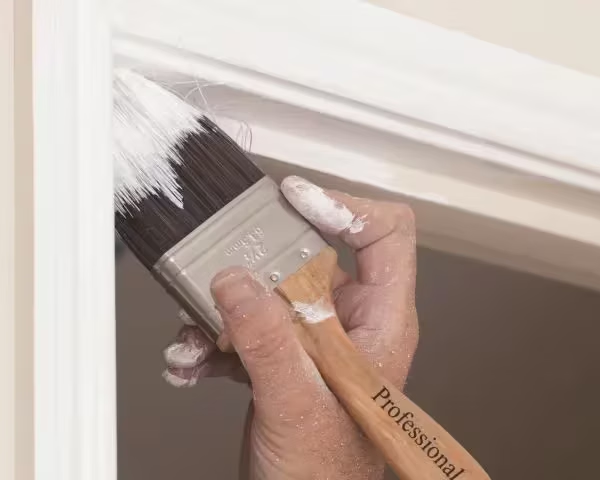
Discover how to touch up a small area of a newly painted surface to conceal repairs to minor damage or to cover up small surface defects.

Discover the differences between water-based and oil-based enamel paints.

All water-based paints undergo a “drying process” involving two distinct phases, evaporation and coalescence.

Find out more about issues and solutions to blistering caused by Hydrostatic pressure.


