
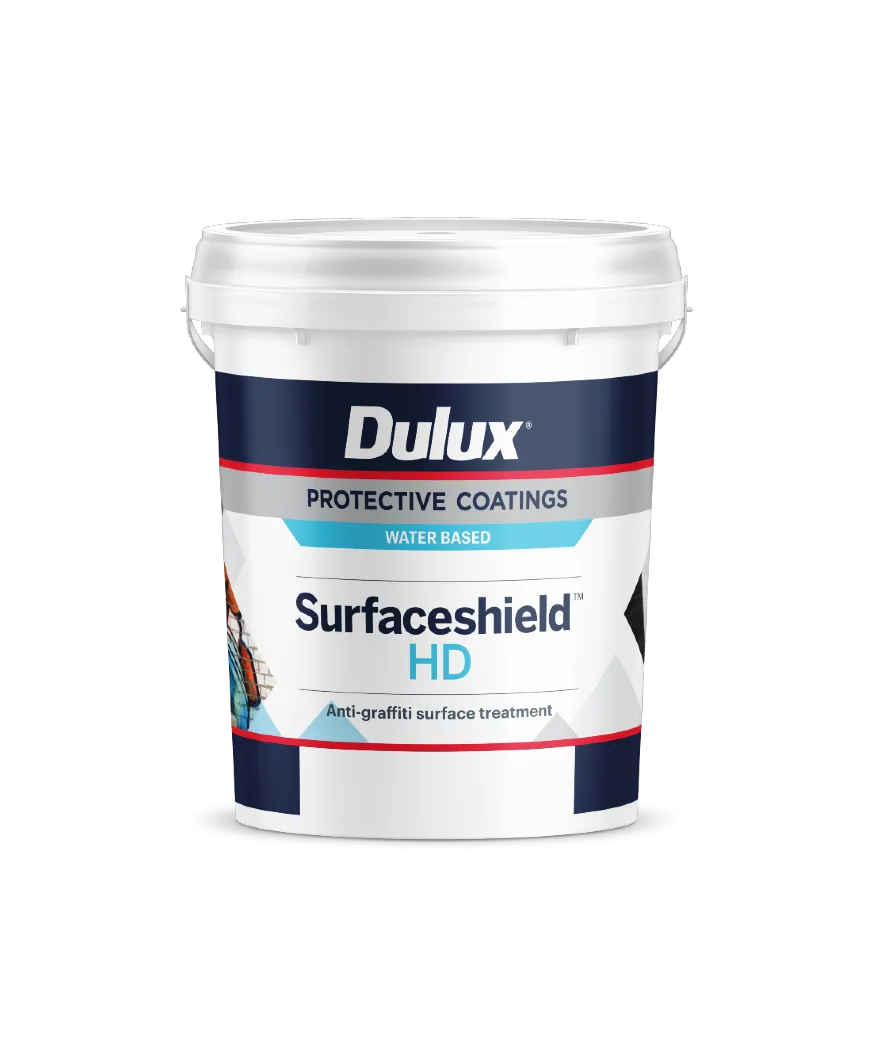

Surfaceshield™ HD (Heavy Duty) is a water-based clear solution for the protection of masonry surfaces against graffiti. Surfaceshield™ HD is a non-sacrificial coating allowing repeated cleaning. Surfaceshield™ HD is non-film forming; it penetrates the porous surface creating a hydrophobic and oleophobic layer. Graffiti on surfaces treated with Surfaceshield™ HD can be removed using a combination of graffiti removal agents and pressure washing with hot water. Surfaceshield™ HD can be used to protect a wide variety of porous masonry materials used in construction, infrastructure, retail, municipality, and public spaces.

Re-coat
Min - 24 hours

Cleaning materials
Water
Application Tools
Air Spray, Brush, Roller
Surfaceshield® HD is an industrial product designed for use by experienced Protective Coating applicators. Where conditions may require variation from the recommendations on this Technical Data Sheet, contact your nearest Dulux® Representative for advice prior to painting.
Do not apply in conditions outside the parameters stated in this document.
Do not apply at temperatures below 5°C.
Where multiple passes are required the product must be applied wet on wet. Excessively rapid drying can limit product effectiveness. Soft and easily damaged substrates, such as limestone and some sandstone, may require specialised preparation prior to treatment with Surfaceshield® HD.
Do not apply in conditions outside those recommended on this data sheet. Dulux® cannot guarantee every type of graffiti can be completely removed. This technology may not be able to protect against graffiti agents which etch the surface. Highest graffiti protection is achieved after 7 days of curing.
Do not use this product for this application without reference to a Dulux® Protective Coatings project-specific specification.
Do not apply on marble surfaces.
1. The surface must be free from contaminants including grease, oil, dirt, bond breakers, previous coatings, sealers, laitance, and loosely adhering materials. An industrial detergent and hot water high-pressure cleaning may be required to remove persistent deposits. Soft and easily damaged substrates, such as limestone and some sandstone, may require specialized preparation prior to treatment with Surfaceshield® HD. Refer to your Dulux® Protective Coatings Specifications Consultant for specific advice.
2. Concrete should be allowed to cure for a minimum of 28 days at 24°C. Application over strongly alkaline surfaces (such as new concrete) will affect the performance of Surfaceshield® HD. To minimise the risk of moisture interference, Dulux recommends the following two tests be performed prior to coating:
ASTM F2659–10 “Standard Guide for Preliminary Evaluation of Comparative Moisture Condition of Concrete, Gypsum Cement and Other Floor Slabs and Screeds Using a Non-Destructive Electronic Moisture Meter”, (moisture content not to exceed 6%); and ASTM D4263 “Standard Test Method for Indicating Moisture in Concrete by the Plastic Sheet Method”, (no visible moisture present).
Mix each pail thoroughly using a power mixer before use. The surface can be either dry or Saturated Surface Dry (SSD)* before applying Surfaceshield® HD. Apply one or two layers of Surfaceshield® HD to the surface being protected, using low pressure spray. It is recommended that application of this product starts at the bottom of a vertical substrate, with the product then being worked up to the top. The amount of Surfaceshield® HD required will increase with increasing porosity of the surface being coated. Subsequent layers can be applied when the coating becomes touch dry. Refer to the Drying Characteristics section for an indication of the spreading rates required for the surface to be protected. Insufficient application of Surfaceshield® HD will dramatically affect its performance and ability to protect the substrate.
*SSD is defined as a concrete substrate that is darkened by water, but which exhibits no pooling or heavy runoff of water on its surface.
Roller: Suitable for small areas only. Apply even coats of the material to the prepared surface. A roller may be used to redistribute material in areas that have become oversaturated with Surfaceshield® HD during initial spray application. Use shed-resistant synthetic woven covers, 4 - 8 mm nap thickness.
Brush: Suitable for small areas only. Apply even coats of the material to the prepared surface. A brush may be used to redistribute material in areas that have become oversaturated with Surfaceshield® HD during initial spray application. Use high quality natural or synthetic bristle brushes.
Mix each pail thoroughly using a power mixer before use. The surface can be either dry or Saturated Surface Dry (SSD)* before applying Surfaceshield® HD. Apply one or two layers of Surfaceshield® HD to the surface being protected, using low pressure spray. It is recommended that application of this product starts at the bottom of a vertical substrate, with the product then being worked up to the top. The amount of Surfaceshield® HD required will increase with increasing porosity of the surface being coated. Subsequent layers can be applied when the coating becomes touch dry. Refer to the Drying Characteristics section for an indication of the spreading rates required for the surface to be protected. Insufficient application of Surfaceshield® HD will dramatically affect its performance and ability to protect the substrate.
*SSD is defined as a concrete substrate that is darkened by water, but which exhibits no pooling or heavy runoff of water on its surface.
LOW-PRESSURE SPRAY: 1.38-2.76 bar (20-40 p.s.i.). A commercial grade pump-up spray tank equipped with a fan tip is also acceptable.
NOTE: For porous surfaces such as sandstone, a process of low-pressure spray and back roll using a shed-resistant 5 mm nap cover is recommended per coat applied.
Persons conducting disposal, recycling or reclamation activities should ensure that appropriate personal protection equipment is used, see "Section 8. Exposure Controls and Personal Protection" of this product's SDS.
If possible material and its container should be recycled. If material or container cannot be recycled, dispose in accordance with local, regional, national and international Regulations.