


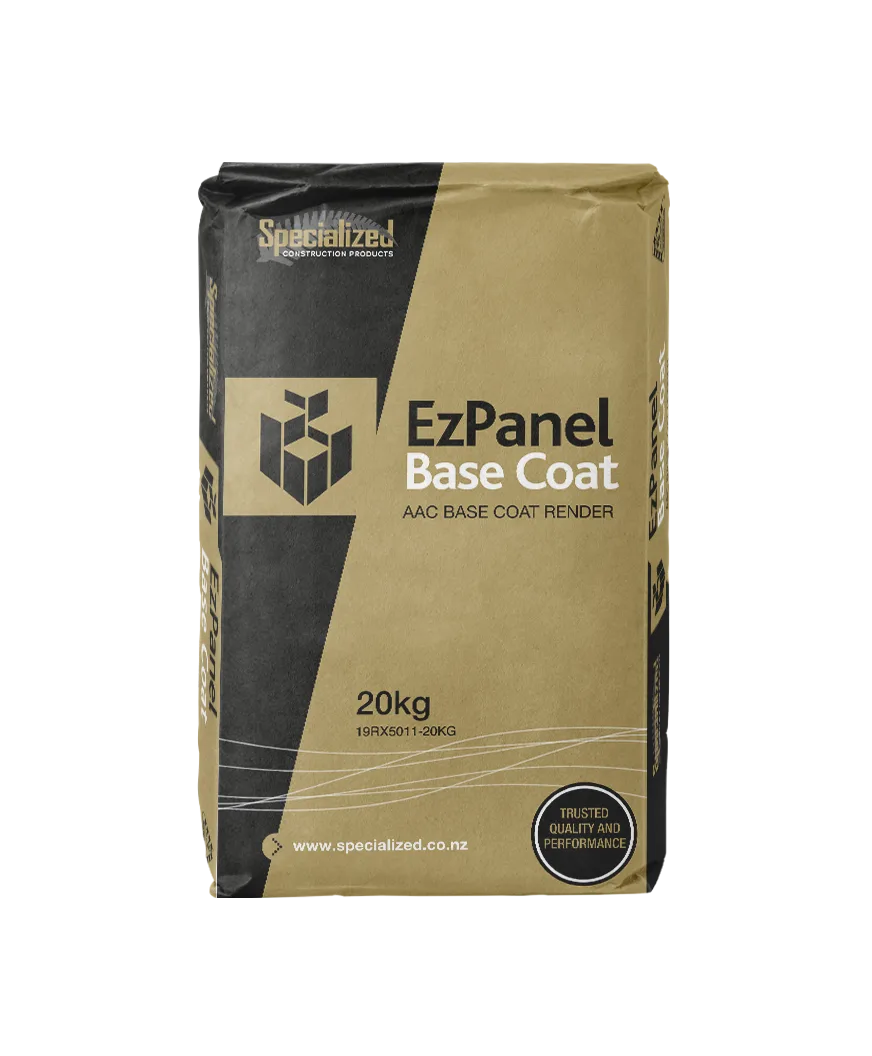
Ezpanel Base Coat is a fibre reinforced polymer modified portland cement-based plaster which is applied over EzPanel or AAC (AutoclavedAerated Concrete) surfaces to provide an even true surface prior to applying a finishing plaster.
Ensure all surface preparation instruction are followed.
All freshly applied material must be weather protected for a minimum of 24 hours after application. Exposure of applied product to rain, snow, dew, or other inclement weather conditions, direct hard sunlight or sources of heat while it is curing may have a detrimental effect on the finish.
The substrate to which EzPanel Base Coat is to be applied must be installed in strict accordance with the manufacture&rsquo ; s specifications and recommended installation procedures. For concrete/masonry substrates the suppliers required curing time must be allowed after installation to ensure the joints in the substrate have completed cured, shrunk, and stabilized. All solid concrete substrates must be fully cured and dry. New concrete must be at least 21 days old prior to the application of any render product.
Surface imperfection such as blowholes, large cracks and spalling must be patched and levelled to the required tolerances and flatness with Specialized render materials before this product is applied. Specialized recommend EZStop plaster. All nibs, protrusions and excess mortar on the surface of the bricks or irregularities in the slab must be ground off prior to rendering.
All surfaces must be clean and free of debris, dirt and dust, efflorescence, grease, oils, curing agents, cleaning solutions, mould and algae or any other contaminants that may affect adhesion. Deeply contaminated substrates must be abraded to provide a clean sound surface. All loose or damaged material must be removed by water blasting, captive shot blasting, or mechanical wire brushing and then washed down before rendering commences.
Painted or glossy surfaces such as power floated concrete must be specially primed, acid etched or mechanically abraded prior to the application of any render.
All cracks that may be the subject to ongoing movement must be correctly repaired and reinforced.
All very porous surfaces should be sealed with an appropriate paint sealer (Specialized Resin) prior to the application of the plaster.
MIXING: Add approximately 5 litres of clean water to a clean bucket and then while stirring slowly add the 20kg bag of EzPanel Base Coat. EzPanel Base Coat should be mixed with a heavy duty electric drill powering a high shear stirrer at approximately 600 r.p.m. The product should be mixed for a minimum of 2 minutes or long enough to provide a smooth lump-free blend. The consistency should be such that the material holds its shape when a finger is run through the surface. Let the mix stand for 5 minutes and give it a quick re-stir before application and adjust the final consistency.
The areas around all penetrations should be completed first by using Fine Mesh Coat imbedded in soft flexible 160g/m2 alkali resistant mesh to all reveals. A piece of soft mesh must be used to reinforce the head, sill and jamb flashing onto the surface of the panels and in the corner of any penetration where the sills and jambs meet. Once all penetrations and awkward areas have been completed all the flat areas of wall should be done using a 160g/m2 alkali resistant hard mesh embedded in EZpanel Base Coat.
The first coat or base coat of plaster is usually trowel applied with a long 20" x 4" or 20" x 5" steel trowel. The large trowel ensures the first coat of plaster cannot be squeezed out too thin. Start at the corner of the wall and apply plaster to the full height of the substrate about one and a half meters wide (the width of the mesh). Apply at 3mm thickness.
Place a layer of mesh (length longer than the wall) against the wet plaster at the top of the wall. Wipe the mesh very lightly at first into the plaster, starting from the middle and working out. Make sure there are no bubbles or wrinkles in the mesh. Once the mesh is flat against the plaster, apply pressure with the trowel and embed the mesh just below the surface of the plaster. Do not force the mesh hard down onto the surface of the substrate. The mesh pattern should be grinning through, but the mesh itself completely covered with plaster. Repeat the process and ensure each adjacent drop of mesh overlaps its predecessor by at least 30mm.
For full system details refer to the Specialized installation guide.
Need a DuluxTRADE account?Head into your local storeorenquire online now.