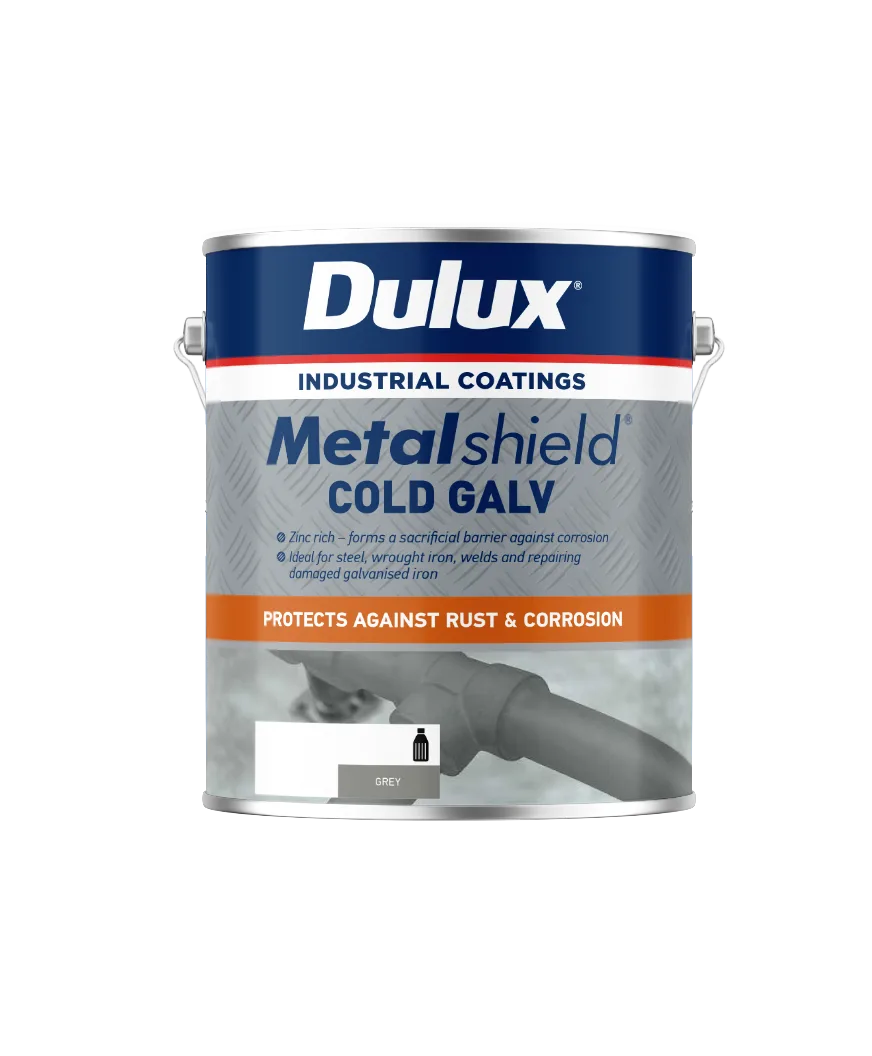

Dulux Metalshield® Cold Galv Primer is a superior anti-corrosive coating for protection against rust and corrosion. Its zinc-rich formulation forms a sacrificial barrier against corrosion.

Touch Dry
30 minutes

Re-coat
3 hours

Cleaning materials
Dulux Metalshield® Cold Galv Thinner
Application Tools
Brush, Roller, Spray
Do not apply at temperatures below 5°C. Do not apply at relative humidity above 85% or when the surface is less than 3°C above the dewpoint. Do not topcoat with two pack products or products of a saponifiable nature such as alkyds.
Steel:
Round off all rough welds, sharp edges and remove weld spatter. Remove grease, oil and other contaminants in accordance with AS1627.1. Rust, millscale, oxide deposits and old paint films on metal surfaces must be removed by abrasive blast cleaning to AS1627.4 Class 2.5. Remove all dust by brushing or vacuum cleaning.
Galvanised steel:
Round off all rough welds, sharp edges and remove weld spatter. Remove grease, oil and other contaminants in accordance with AS1627.1. Rust, millscale, oxide deposits and old paint films on metal surfaces should be removed by hand (AS1627.7 Class 2) or power tool (AS1627.2. Class 2) cleaning as a minimum. Coating performance is proportional to the degree of surface preparation and abrasive blast cleaning to a minimum AS1627.4 Class 2 is preferred for more severe environments. Remove all dust by brushing or vacuum cleaning.
Overcoating:
Aged coating should be tested for lifting by a method suitable to the coating thickness, for example ?X? cut or crosshatch methods. If it lifts, remove it. The surface must be free of oil, grease and other contaminants. Hand sand or high pressure water blast at 1, 200 - 1, 500 p.s.i. to remove loosely adhering chalk and dust prior to painting.
Stir contents of each can thoroughly with a broad flat stirrer using a stirring, lifting action or use a power mixer. Remix thoroughly before using and continue mixing during application.
BRUSH/ROLLER: For small areas only. Apply even coats of the mixed material to the prepared surface. Thin if necessary with up to 100 ml/litre with DULUX CR Reducer to ease application. When brushing and rolling additional coats may be required to attain the specified thickness.
CONVENTIONAL SPRAY: Thin up to 200 ml/litre with DULUX CR Reducer to aid atomisation. Apply using an agitated pressure pot. TYPICAL SET-UP: De Vilbiss JGA 502 Gun: 704 Air Cap, E Fluid Tip, DEX Needle Iwata W70 Gun: 021 Air Cap, 021 Fluid Needle, 021 Fluid Nozzle Pressure at Pot: 70-100 kPa (10-15 p.s.i.) Pressure at Gun: 380-410 kPa (55-60 p.s.i.)
AIRLESS SPRAY: Standard airless spray equipment such as Graco, Binks or others using a 40:1 or 45:1 pump ratio with a fluid tip of 19-21 thou (0.48-0.53mm) at a tip pressure of 13.8-20.6 MPa (2, 000-3, 000 p.s.i.). Keep pot agitated during spraying. Thinning is not normally required but up to 60 ml/litre of DULUX CR Reducer may be added to ease application. Brush, roller, conventional or airless spray.