
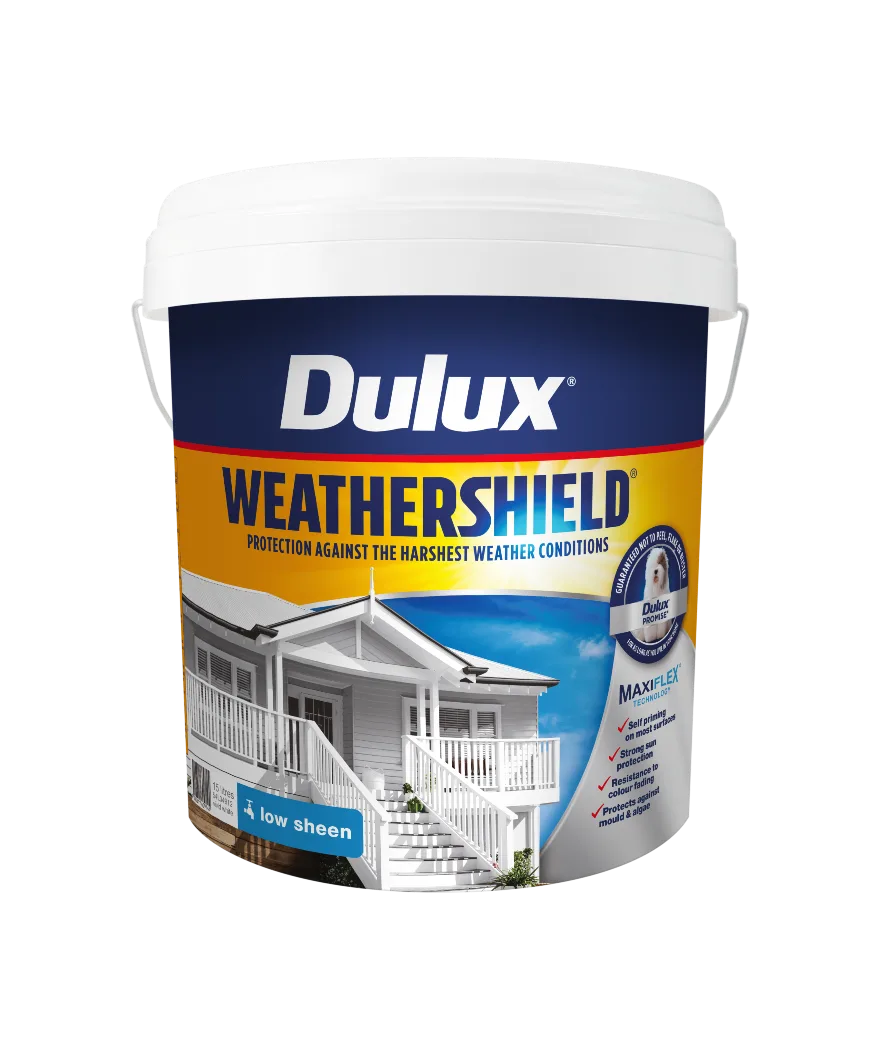

Dulux Weathershield® has been specially designed to provide a tough, hard-wearing finish that provides protection from all weather conditions. Formulated with MaxiFlex® Technology to expand and contract with the surface, Dulux guarantees Weathershield® won't peel, flake or blister for as long as you live in your home.

Touch Dry
20 minutes

Re-coat
2 hours

Cleaning materials
Water
Application Tools
Brush, Roller, Spray
All preparation and painting must conform to AS2311: The Painting of Buildings.
Do not apply at air or surface temperatures below 10C or when temperatures may fall below 10C during the drying period. In summer paint on the shady side of the building. If conditions are hot and windy, cool the surface by hosing with water and paint the cool damp surface. Do not apply to roofs or surfaces used for the collection of drinking water. In normal conditions, 7 days curing is required to develop full hardness and resistance properties. Occasionally when dew or condensation forms on dried film, a slight milky deposit will be observed on the film. This is quite normal and does not impair the performance - simply hose or wipe it off with a damp rag. Dirt pick up and marring on high traffic areas, such as decking, may be more obvious over dark colours. Where possible avoid dark colours on lightweight or panellised building systems as these will give rise to much higher surface temperature that may cause additional thermal stress and cooling demand to the building envelope and/or require extra engineering considerations. Always refer to the substrate manufacturer's LRV recommendation.
Preparing your surface before painting is key to a great result. For optimal adhesion ensure all surfaces are clean, free from dust, dirt or other contaminants prior to painting.
Different surface conditions and substrates require different preparation to get the best results.
Before you start check the weather forecast.
• Temperature must be above 5°C during application and drying time.
• Do not paint on excessively cold or humid days or when rain is forecasted. On cold days, good air movement will aid drying time, and stop painting with enough time to ensure it dries before evening.
• Exposure to rain or overnight dew whilst drying may result in the coating being damaged or removed.
• If painting during the hottest time of the day, paint on the shady side of the house.
• To ensure the previously painted surface is sound, suitable to be painted over, conduct a cross-hatch test.
• To test if you need to strip the paint, cut with an “X” with a sharp knife and press 10cm of adhesive tape firmly across the middle of the cut. Remove the tape quickly. If any pieces of paint come with it, you will need to strip the loose paint off before applying the new top coat.
• Repeat at random in a number of areas to test the surface.
• Clean with Selleys Sugar Soap or in New Zealand Dulux Prep Wash.
• Scrape off all loose and flaking paint.
• Fill any cracks or holes with a suitable exterior filler. Dulux recommends Selleys products.
• Sand all surfaces to a flat finish and remove greyed timber. Dust off.
Bare (unpainted) timber:
• Fill nail holes with a flexible, exterior grade wood filler.
• Dulux recommends Selleys products.
• Sand all dressed timber and remove greyed timber.
• For hardwoods, apply one coat of Dulux 1Step® Prep Water Based for improved resistance to cracking.
High tannin and resin rich timbers
Tannins are water-soluble compounds present in some timbers. In Australia some timbers that can include tannin include meranti, merbau, jarrah, spotted gum, blackbutt and ironbark. In New Zealand timbers include Totara, Matai and Rimu.
• Sand smooth and remove any greyed timber or surface irregularities. For new tannin rich timbers, apply 1 coat of either Dulux 1Step® Prep Oil Based or Dulux PRECISION® Advanced Stain & Odour Blocker. For weathered tannin rich timbers, apply 3 coats of Dulux Weathershield.
Bare brick, masonry, fibro and fibre cement board:
• Unpainted masonry surfaces should be cured for 28 days before painting.
• Ensure surface is clean and clear of any loose sand or cement.
• Fill holes with grouting cement.
• Wash down with water using a stiff brush to remove all loose material.
• To remove any efflorescence (white salts) wipe down with Dulux Concrete and Paving Etch & Clean or a 5% solution of acetic acid (white vinegar).
• Hose down and allow to dry.
• Wash with a bleach solution and/or demossing chemical to remove mould or moss, then hose down.
Galvanised Iron and ZINCALUME® steel.
•For new surfaces clean with a scouring pad and Selleys Sugar Soap
solution or in New Zealand Dulux Prep Wash to dull the surface. Thoroughly hose off.
•For weathered surfaces with a dull finish, ensure surface is clean and clear of loose
and corroded material. Clean with a scouring pad and Selleys Sugar Soap solution, or in New Zealand Dulux Prep Wash. Thoroughly hose off.
• For surfaces within 1km of the sea, and some bases, apply one coat of Dulux PRECISION® All Metal Primer.
Steel and wrought iron:
• Remove all rust by scraping, sanding or wire brushing.
• Apply two coats of Dulux PRECISION® All Metal Primer.
COLORBOND® Steel and COLORSTEEL®
Preparation can vary depending on the quality and condition of the substrate. Define if your substrate is new or old, bare or painted and whether there are any signs of chalkiness or rust. For best preparation requirement for the condition of your substrate ask us in live chat or call AUST 13 25 25, NZ 0800 800 424.
Application Tools:
Brush: High quality synthetic filament brush.
Roller: High quality synthetic roller medium nap (10-12mm) for Low Sheen. Shorter nap lengths result in less stipple, giving a smoother finish but can increase the application difficulty.
For textured surfaces a longer (18mm or more) nap roller is recommended. Allow for more paint for these surfaces.
Painting Tips:
• Work quickly from an unpainted area into the freshly painted area while it is still wet to minimise brush marks whilst maintaining a wet edge.
• When applying on very porous surfaces, thin the first coat with up to 100mL of water per litre.
• When painting window trim, paint while windows are open. Leave for at least 2 hours to dry before closing. Open windows again within 30 minutes and again 2 to 3 times within the first 24 hours.
Painting Maintenance:
• Regular maintenance prevents moisture damage, blistering, mould and paint peeling.
• Washing is recommended in Sheltered/Inland Areas every year and for coastal and industrial areas every 6 months
• For regular washing, use low pressure water to remove dirt and dust. In New Zealand it is recommended to use Dulux House Wash.
• For persistant dirt, use a soft brush with warm water and sugar soap. Rinse and allow to dry.
• Ensure you check for damage or coating failure, if no issues are found, no further action is needed.
• If repair is required, remove loose coating, prime bare spots (on surfaces that are required), and reapply the paint. Then, apply a final coat to the entire panel.
• Repaired areas may differ in apperance due to age, colour matching, texture and application technique.
Spray: 15-17 Thou tip, moderate 1500-2000 psi pressure.
Thinning the paint is not usually required, but up to 10% water can be added to help spraying.